|
|
|
|
Editor's Note
Dear Readers,
Aarya Metallurgicals (India) Pvt. Ltd. stands out as a prominent name in the realm of high-performance refractory products and raw materials tailored for steel manufacturing. With an impressive track record spanning over 20 years, the company leverages the extensive sourcing expertise of its parent organisation, Sino-Global Sourcing & Supply Limited, based in China. The October newsletter of Iron & Steel Review features an engaging interview with Rohit Mishra, Managing Director of Aarya Metallurgicals. This dialogue provides valuable insight into the company’s strategic vision and its significant contributions to the refractory industry. Additionally, the newsletter examines current trends in the Indian steel sector, shedding light on a mixed landscape observed in August 2026.
In national news, Tata Steel Colors Private Limited has expanded its portfolio by introducing its globally renowned Colorcoat pre-painted steel products to the Indian market. Meanwhile, on the international front, SMS group and JFE Steel have inaugurated Japan’s first stamp-charging coke oven battery, featuring advanced smokeless charging technology.
Stay updated by diving into the October newsletter! Happy reading! Santosh Mahanti, Editor & CMD |
|
|
“We aim to establish Aarya as a globally competitive refractory solutions provider”
In the October issue of Iron & Steel Review, we feature an insightful interview with Rohit Mishra, Managing Director of Aarya Metallurgicals (India) Pvt. Ltd. In this conversation, he outlines the company’s strategic vision and highlights its significant contributions to the refractory industry. Below is an edited excerpt from the interview as published in Iron & Steel Review’s October issue.
After more than two decades of experience at your parent company, Sino-Global Sourcing & Supply Limited, what unique insights have you brought to Aarya Metallurgicals to help establish a significant presence in the refractory sector, both in India and internationally?
My experience of over two decades with Sino-Global Sourcing & Supply Limited has been instrumental in shaping Aarya Metallurgicals. It gave me a comprehensive understanding of the refractory industry — from raw material sourcing and manufacturing to technology, customer requirements, quality, and global market dynamics.
One of the key insights I brought to Aarya is that refractories are not just products; they are performance-driven solutions. In the steel industry, every additional heat, reduced downtime, and consistent quality directly impacts productivity and profitability. This philosophy has helped us focus on delivering application-specific solutions with measurable performance rather than competing purely on price.
We have combined Sino-Global’s international experience and technical expertise with Aarya’s strong Indian manufacturing capabilities. This has enabled us to build a company that meets global quality standards while understanding the specific needs of the Indian steel industry.
Our journey is now expanding beyond India. We aim to establish Aarya as a globally competitive refractory solutions provider, driven by technology, quality, innovation, and long-term customer partnerships.
Considering the Indian government’s Make in India initiative, how is Aarya Metallurgicals contributing to reducing reliance on foreign suppliers, particularly in critical sectors like iron & steel, copper, and ferro-alloys?
Aarya Metallurgicals is contributing to the Make in India vision by building strong domestic manufacturing capabilities for critical refractory products used across the iron & steel, copper, and ferro-alloy industries.
Our focus is to reduce dependence on imports by manufacturing high-performance refractories in India, while maintaining the quality and technical standards expected from global suppliers. With our manufacturing facility in Raigarh, Chhattisgarh, we have developed capabilities in products such as Magnesia Carbon and Mag-Chrome bricks, along with monolithic refractories.
Our advantage comes from combining local manufacturing with the technology and technical expertise gained through our association with Sino-Global Sourcing & Supply Limited. This enables us to offer Indian customers reliable, application-specific solutions with greater supply chain responsiveness and reduced dependence on overseas sourcing.
Beyond import substitution, we believe Make in India is about creating globally competitive Indian manufacturing. We are, therefore, continuously investing in technology, quality, R&D, and process improvement so that products manufactured in India can not only meet domestic requirements but also compete in international markets.
For us, Make in India is not simply about replacing imports — it is about building capabilities, creating value within India, and eventually making India a stronger exporter of advanced refractory solutions.
|
|
|
Performance of the Indian Steel Industry in August 2026
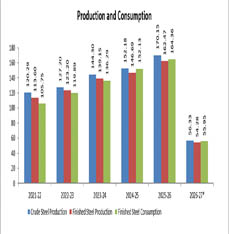
The Indian steel industry witnessed a positive yet measured performance during the first five months of the 2026 fiscal year. According to recent reports, crude steel production reached 70.31 Million Tonnes (MT) from April to August, reflecting a 1.8% increase compared to the same period last year.
Finished steel production, meanwhile, saw a more robust growth of 3.8%, totalling 68.14 MT during the same timeframe. Notably, the consumption of finished steel surged to 70.29 MT, marking a significant 7.0% increase year-on-year, indicating strong domestic demand.
In August 2026, India’s steel exports saw a slight decline, dropping to 0.694 MT from 0.699 MT in July. Conversely, imports of finished steel rose to 0.721 MT, up from 0.702 MT the previous month.
As a result, India has emerged as a net importer of steel during the April-August period of FY 2026-27, with imports exceeding exports by 0.5 MT. |
|
|
Tata Steel Colors Launches Colorcoat® Pre-Painted Steel for India
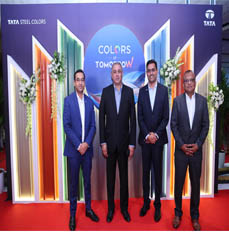
Tata Steel Colors Private Limited (TSCPL) has introduced its globally recognised Colorcoat® range of pre-painted steel products in India, bringing European expertise, advanced technology and proven building-envelope solutions to the country’s growing infrastructure sector.
Developed with coating technology tailored to Indian conditions, Colorcoat® combines durability, aesthetics, thermal performance and sustainability for a range of building applications. Inspired by the enduring beauty of the natural world, the range offers curated colours and finishes with performance to create architecture that is both resilient and visually appealing.
Engineered for hot and warm climates, Colorcoat® offers superior colour and gloss retention, corrosion and cut-edge protection, scratch resistance and long-term aesthetic performance. Its versatile palette of colours and finishes also provides architects and developers with greater design flexibility. Manufactured at TSCPL’s state-of-the-art facility in Jamshedpur, the products will be manufactured, distributed and marketed in India and international markets, extending local access to the global technology and expertise.
The Colorcoat® roofing and wall-cladding solutions are suited to diverse applications, including metro and transit infrastructure, ports, warehouses, distribution centres, manufacturing and automotive facilities, commercial buildings, defence and modern institutional projects.
Praveen V. Thampi, Managing Director, Tata Steel Colors, said, “Our goal is to provide access to advanced global solutions that can help Indian infrastructure set new standards on the world stage. Tata Steel Colors is proud to bring globally acclaimed solutions to the domestic and global market, empowering architects and builders to design for the future.” |
|
|
SMS group and JFE Steel Commission Japan’s First Stamp-Charging Coke Oven Battery
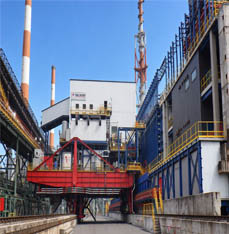
Japan’s first stamp-charging coke oven battery is now operational at JFE Steel Corporation’s Fukuyama Works. Supplied by SMS group, Battery 6-A incorporates Paul Wurth’s SOPRECO® smokeless charging technology to reduce emissions during charging and carbonisation. The development marks a significant technological milestone for Japan’s steel industry.
The battery comprises 52 ovens with an annual production capacity of 420,000 tonnes. It introduces stamp charging to Japan, in which the coal blend is compacted into a dense, stable cake before being charged into the oven. This ensures higher and more homogeneous bulk density, supporting consistent coke quality and efficient oven operation.
To minimise emissions, the battery combines smokeless charging with Paul Wurth’s SOPRECO® single-oven pressure control technology. The system continuously regulates pressure in each oven, increasing suction during charging and the initial carbonisation phase. It helps prevent raw gas from escaping through oven openings and substantially reduces fugitive emissions. An ultra-low NOx heating system further supports stable and efficient heating while reducing NOx emissions.
The project also included turnkey delivery of a Stamping, Charging and Pushing (SCP) machine and a new charging-gas transfer car.
The commissioning marks a significant milestone in the longstanding partnership between JFE Steel and SMS group. Building on the supplier’s earlier deliveries of top-charged coke oven batteries, the transition to stamp-charging required extensive engineering execution and close coordination throughout the project.
Bernard Steenken, CSO, APAC & MEA, SMS group, said the project demonstrated the potential of combining advanced technology with close customer collaboration to meet demanding requirements for emissions, efficiency and reliability.
Kunihiro Nuta, Construction Project Manager, JFE Steel Corporation, stated that Battery 6-A has successfully begun operations as Japan’s first large-scale stamp-charged coke oven. He added that adopting advanced technologies enabled environmental improvements alongside highly efficient operations, and he acknowledged SMS group’s cooperation from basic planning and construction through commissioning and performance testing.
Battery 6-A is expected to serve as a reference installation for low-emission, high-efficiency cokemaking in Japan, supporting steel producers’ efforts to modernise cokemaking assets and reduce their environmental impact. |
|
 |
|
7TH INDIAN STEEL CONFERENCE

16th-17th February 2027
Next Generation Rolling
Technology For
Flat/Galvanised/Coated/Electrical Steel
Conference & Exhibition,
Mumbai
Website: www.isrinfomedia.com |
|
|
 |
|
|